Friday, September 19, 2014

Andy Warhol: Imprisoned in Eternity for 15 Minutes

Mr. Detachment
No one did banality like Andy Warhol. He never had a business card, so who knew if he was artist or graphic artist. For Andy, there was no difference. And anyway, who cared as long as you got paid.

Indeed, he never escaped the charge of poseur, and to his credit, he never tried.

Somehow he tapped the mother-load of a nation’s early-60s spiritual fatigue. And he knew it had a lot do with cash, consumers, and celebrities.

Andy's Selfie
His droning speech patterns. His childlike, gentle observations. His fright wig. His voyeuristic films. He was a way of life, one billion miles from Woodstock and campus rebellions. To complain is to commit, and that wasn't Andy’s bag. He never explained a thing.

He was all for detachment and from the beginning knew it's the observer who adds depth to the painting, never the other way around.

To this day, no one does Andy better than Andy, a monochrome magician, silk-screened with pixie dust, juggling soup cans, still frugging with it-girls, imprisoned in eternity for 15 minutes.


Tuesday, August 5, 2014

Jimi Hendrix: Some of us are looking at the stars

"Your guitar, it sounds so sweet and clear/but you're not really here/ it's just the radio."

- Superstar


The electric guitar of Jimi Hendrix spoke an odd language to everyone that heard it, world over, time and again. People were baffled. It was so foreign. Wasn't feedback to be avoided? Not long after Woodstock, I overheard my primary school teacher say of Hendrix, "What  planet did he come from?" Yeah, there was much day-glo coloratura.

Notice his lyrics have a lot to do with outer space and distant planets, which makes sense considering the cosmic lexicon of his fingers.
Mom & Son: Hendrix begins 

Getting the groove
And similar to an alien that carries no immunity to systematic greed and racism, he became sadly indentured, tethered to lawsuits and fair-weather friends and lecherous relatives and well-wishers’ drugs. A friend of mine met him in Toronto, and said, "He looked very thin and very frail."

If ever there was tragic hero crushed between the tectonic plates of art and commerce, it was Jimi Hendrix.

Visit the Rock and Roll Hall of Fame and stand before his stage outfits. He was slim-shouldered but held out for five years under punishing pressure. Oscar Wilde: "We are all in the gutter, but some of us are looking at the stars."

New York Times: September 18 2025

Neptune probe reveals strange discovery

Performing on Neptune. Where else...
AP - New York - NASA’s small but determined Columbus 5 probe that has been scouring Neptune for the past two weeks made an unusual discovery today. What can be described as balls of used electric guitar strings rolled down the blue plains like dancing tumbleweeds. Scientists are puzzled by the strings and the odd sound made by the warm winds which, they say, is reminiscent of singing and amplified feedback.
###

So wish Jimi well on his beloved Valleys of Neptune where every night forever he plays under the stars and the face of God...sweet and clear.

Friday, July 18, 2014

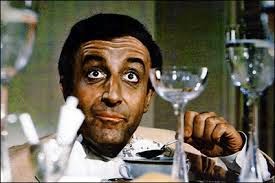
Peter Sellers - When the Fake Exceeds the Original


Ursula causes high blood pressure
Spike Milligan said Peter Sellers was not a actor, but a freak — and meant it as high praise. Sellers’ aptitude for mimicry was so far beyond the norm, there had to be something else going on. Possibly he was sad heir to a Frankensteinian alchemy endowing the chosen to speak with genuine voices — yet unable to fake souls.

A freak? An article about Sellers in a 1960's edition of Vogue suggests that it’s genius when we accept the veracity of the fake over the fiction of the original. Director Stanley Kubrick was astonished at Sellers' seemingly limitless talent - and astonishment was rarely a Kubrickian reaction.

A Frankensteinian alchemy
That Sellers was mentally ill - yet functional - is tribute to his will power and the more morbid aspects of the entertainment industry.

There was about him sadness, a technical detachment that veered away from ensemble performances and aligned him with gadgetry — anything that wasn't alive. His best work is seen in films with thin plot lines — because  Sellers never belonged to anything, let alone himself. He was no good at life.


Not Being Anywhere
Every girlfriend, every wife, every movie, seemed to further eviscerate his damaged heart. And when the end arrived, a slumming deity gazed from a cloud and pronounced, “Let him speak to us all in the voice of God — because God is hard to imitate. Plus, He never makes us laugh."

Sunday, January 26, 2014

Joe Namath Long Bombs to the Hands of Time


CC riding with Ann-Margret
Until he appeared, professional sports strained to be wholesome, bursting with brush-cuts, white teeth and ponytails. Stadiums rattled under Romanesque, military vibrations, and the pre-game national anthem forged a linked between competition (war) and nationalism (war). Athletes were to appear humbled by their talents for—after all—accomplishments are attributable to clean living and supplication.

But Joe Namath didn’t give a hot damn about any of that. He was egocentric, boastful, drank, partied, bedded legions of women and—this is the spoiler—won games. In fact, as quarterback for the New York Jets, he QB’d the win for Super Bowl III in 1969. Not only did he win, but a few days beforehand, he, the underdog, predicted his team would win, an up-to-then outrageous and inappropriate attitude. It drove the Brush Cuts crazy. Hell, he even made Richard Nixon’s enemies list, and Nixon loved football.

His career? Namath tossed 220 interceptions to his 173 touchdowns and compiled a quarterback rating of only 65.5 – the lowest career rating for any quarterback who has ever won the Super Bowl. But why focus on that? Focus on The Game, sweetheart.
Namath lookin' good

With good looks and an ironic sense of humor, you have a guy that should be in movies, and he was, getting down with Ann-Margaret on motorbikes.

First, you gotta win
What the Brush Cuts didn't understand was that Namath, even with his pimp hat and fox-fur coat, his swinging bachelor pad and TV commercials, came a lot closer to embodying the Constitutional qualities of liberty and individualism than they ever did, with their ‘yes sirs’ and drip-dry beliefs. Namath was a Hail-Mary-throwing embodiment of the American Dream, a risk-taker, an innovator, a leader.

His legacy can be found on a tropical island, reclined by a beach, laughing with a sumptuous blonde, now and then standing to whip a long bomb over the waves, secure with the knowledge that it will always be caught by the hands of time.

Wednesday, January 15, 2014

The Beatles: Forever On Their Way to Capistrano

"I think their music could only appeal to adolescents and retarded adults." - Shirley Mair, Macleans Magazine, 1965


There was so much talent that you ignored the raw ambition. How else to explain our willful disregard of their psychotic work regime backed by matching haircuts and suits. The first drip-dry, bespoke boy band.

In (less than) three minute segments, infused with jangling guitars and timpani, Lennon and McCartney delivered truffle-weight paeans to teenage angst. For a brief time, they were the best in the world at it.
Forever winging through the great cosmic clouds

But then something happened. The great space-time tidal bores of fate, talent and time criss-crossed like never before. Drugged-out rock musicians became prominent and respected social icons. And the Beatles reigned from the electronic Olympus of sound reproduction.

But against all expectations, they just got better and better. They actually improved. ‘She Loves You’ was subsumed by the layered dream scape of ‘Strawberry Fields Forever’. ‘Can’t Buy Me Love’ belonged not only to a different band, but a different century, than ‘I Am the Walrus'.

Massive WTF.

The Beatles were embedded gypsies of the day-glo, patchouli-laden 1960s, so hyper-responsive to both their temporal and secular surroundings, that they could move swiftly, without footprints, from Los  Angeles to Rishikesh, from the dank bricks of the Cavern Club to the swirling valleys of the Himalayas.
The absolutely last group photo

By the time an entire generation became lost and despondent on the long and winding road to nowhere, the Beatles themselves had vanished just as fast as they had arrived, leaving few clues to their genius, never to fully reform (anticipating the extreme fragility of collective memory).

Long after their peers have been sealed up silent in tombs of black vinyl, the Beatles are still heard, disembodied melodies, riding the backs of swallows winging through cosmic clouds, forever on their way to San Juan Capistrano. 


It's the next best thing to be...


Friday, July 19, 2013

Richard Farina and Roman Candles


“The only people for me are the mad ones, the ones who are mad to live, mad to talk, mad to be saved ... who never yawn or say a commonplace thing, but burn, burn, burn like fabulous yellow roman candles exploding like spiders across the stars.”

― Jack Kerouac


The poet, the writer, the singer
Richard Farina was more than a cross-over figure of the 1960s, conjoining the folksy, woody-guthrie-depression-era-communist sing-alongs with the electrified, drug-infused, youth-enabled latter half of the decade. He sang with Pete Seeger and jammed — kind of — with Bob Dylan. He did that —but he was more.

He married Joan Baez’s sister, Mimi, (of whom critic Greil Marcus once wrote she was so beautiful it was hard to look at her) and was a college pal of Thomas Pynchon.

1966. Farina died in a motorcycle accident, age 29, after the launch party of his only novel Been Down So Long It Looks Like Up to Me. The book is more interesting than great, part relic, part testament, with the loopy, lasting and atavistic appeal of an Easy Rider. The talent was there.

Richard and Bob

And the talent was in his poems, songs and singing. You can feel it. He was driven, ambitious, creative, and young—and it was the 1960s and beatniks were hanging at the coffee bars while the hippies began the Quest for Woodstock.


Rich and Mimi go for it
Does a short wick burn brighter? Never. Then what to make of this Roman candle with a ghostly shadow, his trembling voice and votive glow that flows across the stars.


Sunday, January 27, 2013

Gimme Shelter: Merry Clayton’s Scream of the Decade


What happened that night? The Valkyrie circled above black clouds, ready to break cover. 1969. The earth itself was unstable. Mick Jagger sounds defiant but scared -“See the fire is sweepin'/ Our very street today/ Burns like a red coal carpet/ Mad bull lost its way.” Mad bull?


Merry Clayton gives up the ghost
O Lord Gimme Shelter. The Stones sang of Apocalypse Right Now. The center could no longer hold. Every musician for himself – or herself. Even the harmonica has a death rattle. And singing backup was Merry Clayton. On her own among the most satanic of lyrics – “Rape, murder! / It's just a shot away/ It's just a shot away.”

She holds on tight for the first two shrieking invocations. But as she approaches for a final time, at three minutes into the song, something happens. Something no one, not even Merry, was prepared for or has been able to repeat in the same way — and never will. That’s the solitude of true magic.

Alone and abandoned, she takes war and rape and murder and poverty and riots and racism and blasts it all into a howling jet stream scream, mainlining out into darkness.

And her voice — that has held on for dear life until now — gives up the ghost. It's too much for one of us, let alone a nation, and the voice cracks on ‘murder’, and in doing so, releases an eternal, auditory bookend to that most confusing of times, an almost inhuman plea of frustration, that we must go beyond our flesh — but cannot. We just can't.We have limits.

Listen carefully at that moment and you can hear Jagger call out in shock – because he knows it can never get better – or worse – than this. And it never did.

We’re told “[Merry] suffered a miscarriage upon returning home, attributed by some sources to the strain involved in reaching the highest notes.1

Let’s hope instead that the scream was heard by a slumbering god, hidden in a celestial cave who awoke uncertain of himself, confused by a dream about beautiful dolls he'd made long ago that were now singing in their chains like the sea.

1‘Gimme Shelter’ Wikipedia

Thursday, January 3, 2013

Au Revoir Playboys of the Western World


Hefner - the only man able to prosper as a playboy

A playboy — as conceived by publisher Hugh Hefner — owes much to 1950s America, the decade of his birth. No matter how many times Hefner tried to reboot his pipe-smoking Lothario into a more contemporary milieu, it didn’t really work. His jazz-swinging, cocktail-swirling bon vivant had nothing to do with the 60s counter-culture. He just wasn't cool.

And the disco-era was too dumbed-down for a guy who grooved on space-age vibes, Lenny Bruce and Stan Getz. The Playboy clubs became a kitschy anachronism and finally hit the wall. Eventually, Hef’s priapic creature lumbered into bed with soft porn, gobbled a Viagra, and then did it for the Gipper.


Rubirosa: Human pepper grinder
Post-WW II, real life playboys, as typified by Portfirio Rubirosa and Gunter Sachs, managed to rat-pack their way from the lizard lounges to the Whiskey-A-Go-Goes, and along the way learned how to stuff a wild bikini. But pop critics dismissed them as Euro-Trash, living off the avails of rich wives/girlfriends, or, in Gunter’s case, a substantial inheritance.

Gunter and B. Bardot (his wife)
So the playboy of the western world was forced to live with the Undead of Monaco and Vegas and Gstaad or any of those places that Peter Sarstedt knocked off in Where Do You Go to My Lovely – the ultimate anti-playboy/girl anthem.

In the end, following an all-night party in July 1965, Portfirio ran his Ferrari 250 GT into a tree in Paris, and violently removed himself from an era that was gearing up for Monterrey Pop. As for Gunter, he somehow made it to 2011, and then ended in suicide.

But those are just two high profile swingin’ guys. Millions of playboys got strangled by their own silk ascots, weighed under by their Peter-Lawford-sized sideburns, washing up on Malibu Beach, gamely clutching an Old Fashioned or Bloody Mary, gasping for one last listen to Herb Albert’s Whipped Cream LP.

Swingin' Guys...Swingin' Gals
And the pretty young girls who danced beneath the diamond sky, over the white sand, were too busy humming The Jefferson Airplane to even notice the tired mad men of yesteryear, now rolling in the waves, to be pulled out to sea.

Through it all, Hefner, clad only in pajamas and slippers, pads on, in a hermetically-sealed, time-resistant Miss Havisham biosphere, Vampire Number One, indestructible, and surely given to celebrating the colossal irony that the only man ever able to truly live as a playboy — and flourish — is Hugh Hefner.


Friday, November 16, 2012

A Tragic Confluence: Charles Manson and the Danse Macabre

It was a terrible, tragic confluence of illness, character, and chronology. And Charles Manson's mental state prospered.


We all began as kids...

His messengers were much like him – outsiders, dispossessed, the psychotic, the poor and desperate. Yet under the shambling guise of California hippies, replete with guitars-by-the-bonfire, no-money, communal living and free love, they murdered with glee.

Manson knew the end of the world was nigh, that African-Americans were plotting to subsume white culture, that he was the only guy who recognized this and the only way to get control was to ignite a race war – to kind of get the jump. Hence, ‘Helter Skelter’, a term he borrowed from his very own personal prophets, the Beatles, a term that, for Manson, implied a significant military strategy.

So he'd sent out his Zombie-Hippies at night, and they would return to the compound/commune fresh from successful sprees of premeditated, debauched murder. One of his victims was over eight months pregnant. Manson became a proud, energetic leader. He had plans to expand.

All of this happened just a few months before Woodstock. Flower Power had grown a malignant, creeping vine yet no one noticed. Manson demonstrated how fragile the whole leaderless, youth-based, drug-oriented subculture really was.

Mental illness in full flight

Whereas Bonnie and Clyde wouldn’t have had much of a career in our retina-ID, DNA, chopper-patrol, insta-cash, WiFi world, so Manson, without the off-the-grid, tie-dyed infrastructure of late 60s California, would have been just another sick hipster, hustling street corners, knocking off dime stores, to be killed in a knife fight at the back of a pool hall at 3 a.m. and forgotten forever.

The times don’t always make the man. And the man doesn’t necessarily make the times. (When it goes wrong, they embrace and whirl each other across the floor in a danse macabre while the rest of us line the walls, Easter Island-like, to witness a timeless, terrible harmony.)

Sometimes they make each other.

Tuesday, June 19, 2012

Laugh-In. Sit-In. Bed-In. Be-In.


The first thing you noticed about Laugh-In (1968 - 1973) were the colors, unknown to network television until then. (Color TVs had been around for a few years, but no one maxed the possibilities).The swirling paisley, the gliding stripes, the undulating tie-dyes. Suddenly, ‘Gunsmoke’ made no sense. 'Bewitched' played in a Victorian drawing-room.

Alan Sues, the kiddies' pal
Then you had the attention-deficit-disorder-Jean-Luc-Godard jump cuts. Nothing lasted more than a laugh. No point. On to the next skit. Sock it to me baby…

It was a non-stop party somewhere in Malibu, maybe, after dinner-by-the sea and white sand, where real groovin’ hippies commingled ‘round a roaring fire with anachronistic swingers like Peter Lawford and Douglas Fairbanks Jr.


Goldie's bikini
It was never supposed to work so well. Laugh-In began as a one-time special — then skipped down the streets of Burbank like an day-glo clown, snatching Emmy awards and championing Hollywood careers.

No single TV show nailed the west coast pre-Manson 60s zeitgeist quite like Laugh-In… Interracial couples, thinly disguised drug references, micro-mini skirts, left-wing politics, anti-establishment…

Through it all you had two tuxedoed lounge-lizards, Rowan and Martin, a smart guy/dumb guy Vegas routine, vaudeville zapped by hellzapoppin’. Incongruent enough to be cool … One of its young writers took thick notes, underlined ‘Controlled Anarchy’, jumped a Greyhound, and headed east.


Very interesting..
It was hugely influential with pithy slogans that go-go danced their way into the slinky lingua franca. It opened doors on a wild house party that was just tame enough that squares felt hip, and just square enough that the hip could condescend.

Vietnam. Drugs. The draft. Kent State. Racial inequality. Joplin/Hendrix/Morrison. Assasinations. The protests… Pigs off campus… What’s so funny?

Out of misery is born magic.

A poem by Henry Gibson
No surprise the show ended along with the Sixties — that is, pre-Watergate. No place for bikini-clad jokesters — too vulnerable, too kooky… A more serious society required less serious comedy.

But then, one evening, unnoticed and without fanfare, a ghost-driven black cadillac began a dusty path across the country, from Burbank to the Big Apple, with crates of restless souls in the trunk, moaning for prime time, about to go Live from New York.

Monday, April 23, 2012

Marilyn Monroe: August 5, 1962

"Bound to adore you, fatherless child"

Au revoir Marilyn...if there's a wish, pay your visit to Mr. Dickens. For he, like many another literary man, is bound to adore you, fatherless child."

- Norman Mailer

"Dream baby dream...forever"

- Alan Vega/Suicide

Help I feel life coming closer
When all I want to do is die

- Marilyn Monroe


Ah... the patron saint of Beautiful Losers.

Anyway...

They got it wrong. Narcissus wanted to drown.

... Her appeal? ... just make it back into her arms and nothing could ever get you. No guilt. No nothing. Held forever in the soft embrace of death and forgiveness.

She once called the ocean 'a big mother'. She knew.

So she might say... “This evening it’s only us. Forget all before and all to come, stroll the sand 'til twilight and watch the waves roll in.”

"Dream baby dream...
Maybe it was the way she ignored fate, just tempted it, at night her eyes in a come-hither and lips parted, while each morning, unsure and weak, she steadied her sanity against the walls of her own tomb and bled out the voices in her head. That took real guts.

She was — and went the way of — all flesh. It's puzzling — with her unseen — she has become even more.

Forever...
That baby doll voice whispers a prayer more than a promise... And you leave her alone at dawn. You're supposed to. Just like everyone else before.

For she belongs now on the coastline, wet hair, and cold salt spray running dark rivulets down the curved glass of her face and body.

Strange the way things work out. A sepulchral blonde asleep and curled on mink, dreaming of life ...forever"

...and Ever


Monday, February 13, 2012

Capucine: Snow Angel

‘Capucine’. One word, an icy brand distilled from the warmer ‘Germaine Hélène Irène Lefebvre’. But then her elegance didn’t permit intimacy. And that was her appeal. A snow angel with dazzling detachment.
Who would believe such a thing?
Born 1928. A Parisian model at 17, then into films. She was surprisingly adept at comedy, a genre strangely receptive to manic depressives. Without darkness we can’t know light?

She was saved from suicide more than once, but who would believe such a thing? The cheekbones, the plush lips, swept-back mane, the porcelain skin, who would believe it?

It’s 1952 and she lands a 2-week modeling gig aboard a French cruise ship and shares a cabin with Brigitte Bardot, 17, a chorus dancer. O pillow talk. Who would believe it?
With Peter Sellers
“Men look at me,” she opined, “like I'm a suspicious-looking trunk, and they're customs agents.” There’s a difference between beautiful and pretty — and in the face of beauty men grow wary, weakened by exposure to the spiritual, anxious to resume a cosmetic, manufactured appreciation.

She also said, “"Every time I get in front of a camera, I think of it as an attractive man I am meeting for the first time...” All the best faces know — instinctively it seems — the camera is a mirror in which you
Poor Snow Angel
slowly, with great art and artifice, seduce yourself, make love to the flesh and fear and forget-me-nots that are you. But therein lays disease and finally, after injecting one too many color chemical emulsions at 1/60th of a second — a kind of walking madness. Narcissus didn’t drown. He couldn’t tolerate the terrible pain of perfection — even his own.

So in 1990, she ended herself. A bi-polar decision lending a polar patina of white frost spangled like sapphires trailing the gorgeous curve of her neck.

The word 'Capucine' is French and refers to flowers. But poor snow angels, they never live to see spring.

Friday, February 3, 2012

Sonny Liston: A Phantom Punch from an Unseen Fist

There’s was always something about Sonny Liston. Always rumours. Maybe the mob connections. Maybe the way he threw the second Ali fight, or his weird death in Las Vegas.
Nobody punched harder

It was as if he saw something out of the corner of his eye, a phantom, something fleeting and cruel.

Maybe he was waiting for something, a meeting that he could delay if he just belonged somewhere for once, if he just punched hard enough, if he only endured enough pain because pain — both delivered and received — lets you know you're alive. So he tried: nobody punched harder and with more debilitating force than Sonny Liston.

He had to. He had to smash his way out of poverty and jail and racial discrimination and… you know this tune — it’s 12-bar blues but in a minor key.

People spoke of his silent stare — eyes of a corpse, face drained of blood having taken such savage beatings at so young an age. But Sonny never complained, never explained. He didn't have to — because it was always between Sonny and the Big Man, not people. Shit, people were trouble. Best to avoid their bank accounts, their push-ups bras, their handguns. Best to fight then flee into the night.
Just as he expected - a Big nothing

That something he saw, that shadow boxer, that bemused trickster who led him pawing through the black & white crowds of yesterday’s newsreels, heaving cigar smoke and screams, the women all hollow-eyed girlfriends, coiled off men’s arms, the men themselves straining veins and broken fedoras.

And so in May/65 Sonny once again met the newly minted Muhammad Ali. (Of all the men I must battle, why O Lord do you face me with the best of them — ever?)
Iconic photo. Ali/Clay over Liston

Previously beaten by Ali even though he had managed to lace nitric acid on his gloves and grind them into Ali’s stinging eyes, this time Sonny said screw it and took the fall just half-way into the first round.

First round? Sure. If you’re going to drop, why take a beating? Makes sense. They called him a stooge — and a lot worse. Some people called it a phantom punch. They had no idea how right they were. Sonny had seen the Phantom all his life... leaning in the corner of a jail cell, by his bed as he lay back, cut and gutted, having survived one more predator. Anyway, some say the mob had threatened his wife and children - which makes sense because Sonny Liston was no quitter.

After that loss he boxed in Europe, did well, but never got back to The Garden. Meanwhile, Ali danced around him and out into the whirling kaleidoscopic stratosphere of 1960s pop culture heroism. Sonny couldn’t shake the grey smell of backstreet whore houses, always the shadows, the pay phone whispers, the film-noir headlights sweeping his motel window and god knows who’s going to get out of the car with something heavy in their hands.

"Lord, you made the night too long"
It's appropriate Sonny died alone in Las Vegas, a city that always been uneasy around strength. The Phantom raised His fist for a final, merciful blow. And Sonny lowered his arms, unguarded now, exposing his ragged soul, and closed his eyes to Nothing, just as he had expected. A Big Nothing.

And then down he fell for the infinite count to a white sea of foam canvas, he a silent cipher, just damaged goods drifting over the planet, more a ghost than a demon, less a man than a wordless tale of a brave spirit fighting forever under endless blows from unseen fists.

Saturday, July 2, 2011

Veruschka: An unwavering sense of purpose

1944, East Prussia. Along with a small group of fellow heroes, Heinrich Gräfin von Lehndorff-Steinort attempts to assassinate Adolf Hitler using explosives packed in a briefcase. The assassination fails and Hitler retaliates a few days later by having Heinrich — and his brethren — murdered.

Heinrich was Veruschka’s father.

That's our back story.

The ancient Greeks believed there are three aspects to beauty: symmetry, proportion, and harmony. But that analysis doesn't touch on the moment of inception. Can beauty be borne of tragedy? Could such circumstances hyper-inflate the Greek triad?

We all know that beauty is a lot more than strategic bone structure and straight teeth. We know that there’s a mystery to it, that it’s somehow intertwined with personality, with a particular attitude toward Life — and Death. We all know that.

And we know that Death and Sex are close friends. (That's the thin mystery of James Bond). They need each other. Perhaps the relationship seems abusive, at least while you’re hidden, memorizing their slow movements through a window. But they’re opposites and each finds the other bewitching and dark and dangerous.

Beauty and Life are what remains when Death and Sex leave the party. Beauty is dumb fun. Life lies, all the time, without exception, to every one.

When Death ends up with Beauty, you get fallen angels — such as Vera Gräfin von Lehndorff-Steinort, our Veruschka, one of the top 1960’s models.

After Heinrich’s murder, his daughters and wife passed the war in labor camps. They were lucky to survive.

By 1960, Veruschka was a full-time model.

Richard Avedon called her the most beautiful woman in the world…but you know those photographer types…By 1966, when she appeared in Antonioni’s ‘Blow Up’ (in the most celebrated/imitated photographer – model sequence ever filmed) she had hit the big time.

Watch that sequence today. She had been sick and was too skinny and weak. Are those eyes dead or disengaged, jaded beyond salvation or in hiding? Maybe beauty gets its strength from the soul: it’s a direct current wired straight through the eyes. You rarely see Veruschka with sunglasses.

That’s her quality, deep-cave inscrutability that finds light even under coats of body paint, an art form she developed long before it was an art form. (Inscrutable for sure: What's she doing at James Bond's gambling table in 'Casino Royale'?) Veruschka was the first to understand that models need background a lot more than background needs models…so she became the background, disguised and melding her thin form, naked and still, a child resting, pushed out of its cloudy nest.

1965
Perhaps it was her defiance, born of that Death-Sex alchemy, so different from the daffodil-swinging marianne-faithfuls of Carnaby Street, a toughness that somehow redefined obvious vulnerability, that lightly lampooned Beauty, that
made Sex seem more of a challenge than a pastime.

Her father was brave, not a transferable quality, but one that can be attained through a deliberate, unwavering sense of purpose, be it facing death… or the cold dead glass of a camera.

Sunday, February 13, 2011

Tara Browne: a little life rounded with a sleep


...our little life...
rounded with a sleep...

Guinness Heir, 21, Is Killed In London Sportscar Crash

LONDON, Dec 18 (1966) - Tara Browne, 21-year-old heir to the Guinness brewery fortune and a leader of London’s “mod” social set, was killed early today when his sportscar smashed into a parked truck in the South Kensington district.

- New York Times

There are some people whose purpose in life — in a cultural sense — is to offer context to the lives of their contemporaries. They are rarely catalysts for action; rather, they provide a kind of mood music or a subtext for movement. Tara Browne (1945-1966) was like that.

The short, happy life of Tara Browne survives in print and pictures for what he represents, not what he did (although his twenty-one years were not without merit and accomplishment). And what he represents is that burst of color and noise and fashion that ran amok through the Carnaby district of London, from about 1964 – 1970, give or take.


Melted into thin air
Perhaps he represents a little more. By its very nature, ‘Pop’ doesn’t do anything, doesn’t feed the hungry or house the poor. It just is, like Tara. No creativity required, no mesmeric eloquence or moon-lit beauty: you just have to be there in the right place in the right clothes. That’s it – but it’s not that easy because we only know where there is in retrospect. Tara seemed to know.

Browne  spooned some of his inheritance into a fashion store called Dandy (on King’s Road) which sold clothes made by his tailoring business. He also had a failing marriage, kids and girlfriends.


A brief, happy life
He was a little bit Edie Sedgwick, a tiny touch of Porfirio Rubirosa, a dash of David Bailey, a pinch of Sir Guy Grand — with a lime wedge of poor-little-rich-kid. He was well liked. When Tara died, John Lennon wrote about it in ‘A Day in the Life’ and the Pretty Things recorded the more literal Death Of A Socialite’…Every little bit counts.

Our revels now are ended. These our actors,
As I foretold you, were all spirits and
Are melted into air, into thin air…
We are such stuff
As dreams are made on, and our little life
Is rounded with a sleep.


It’s been suggested that when Shakespeare wrote those words — almost the final words he ever wrote — he was saying that all art is ephemeral, nothing more than thin air. He was wrong of course (as his own longevity proves — and he knew in his heart): art, just like a person, endures if it — or they — touches the Truth.

Whatever smartly-dressed Tara Browne discovered long ago - under a white Mary Quant umbrella -dancing in a warm rain down Kingly Court - is a mystery - but it must have been some wonderful, deathless, fashionable Truth.

Thursday, December 16, 2010

The last detachment of Ken Kesey

As I sat in the audience that evening, watching Ken Kesey read from his book ‘Demon Box’, I got a strange, low-level vibe. The clues were subtle — inflections of his voice, the way he swayed slightly at the podium, his contextually-wrong smile — that he wasn’t really engaged to the text.

Sure enough, after a few minutes, he suddenly looked at his watch and joked that “right about now” his favorite NFL team was likely losing.

And it was a good story he had been reading — about meeting The Beatles.


Kesey himself was a hard read — an evasive mumble of contradictions. The high school wrestling jock who condemned smoking but loved LSD. The soft-spoken, reflective author who blasted across the country with his pals in an old school bus, fueled by drugs and hard rock, periodically stopping to pull pranks because, hey, they called themselves The Merry Pranksters. (Paul McCartney heard about Ken’s road trips and wrote ‘Magical Mystery Tour’). The writer who rarely wrote, as if adopting an outré lifestyle as a response to charges of indolence.


Detachment — that was the foundation of his loopy, sometimes childish, often self-engrossed, kinda provoking but rarely boring public persona. He knew when to cut out and get back on the bus.

Kesey wrote one great book, ‘One Flew Over the Cuckoo’s Nest’, and it arrived before the whole 60s trip began. Tom Wolfe’s ‘The Electric Kool-Aid Acid Test’ made Ken a cultural icon. It gave him a stage but took away his writing.

Ken, one of the big time personalities of the west coast counter culture. The wide-grinning shaman with one hand holding ‘On the Road’ while the other spun The Grateful Dead’s ‘Anthem of the Sun’. Part hipster, part hippy.

That detachment let him walk through cultural walls with n’er a scratch… a day-glo clown, a rock culture Robin Hood, taking from the squares and giving to the groovies, turning on, tuning in, but never dropping out, equally at home with Neal Cassady or Timothy Leary.

Leary and Cassady: Party on

Kesey peaked early, and spent the last half of his life interpreting the first. So there he was, white-haired and stout, still hanging in the bus, driving across the U.S.A., now more a portable party than a quixotic quest.

The author as performance artist, the goof as holy fool. It’s hard to follow Kesey because he never had a map. The bus went where it did, no plans, no right or wrong way, rambling along the blue Pacific until a day in November 2001, when it pulled over for the last detachment and Ken waved goodbye to his friends and got off alone, without books or words or drugs or anything, and flew over the cuckoo's nest, arms wide open.