Wednesday, September 13, 2023
Diana Rigg: True to Her Own Spirit
Tuesday, June 27, 2023
Jacqueline Kennedy Onassis: Cultured Queen of Branding
Gertrude Stein, reflecting on her childhood home in Oakland,
California, famously said, ‘There is no there there’. When considering Jacqueline
Kennedy Onassis, that quote seems somewhat applicable.
Biographers have had a tough time with Jackie. She was
manipulative and false; she was genuine and kind; she demonstrated women’s
empowerment; she was a submissive cuckquean; she was little more than a hat
rack; she was a style icon.
![]() |
| Where is the 'there'? |
It’s this Zelig-like quality that perpetuates her persona. For millions of people, she is whatever they want(ed) her to be at any given moment. When she married John Kennedy in 1953, she knew the score. But it was worth the ride. The money, fame, and glitz. Then Dallas. And then a slow, five-year reinvention before shacking with Aristotle Onassis and big bucks.
She was vilified for selling out, for stamping on love with
lucre, but the critics
undervalued her survival instincts. She needed
that Fifth Avenue apartment to support her brand—for the brand was everything;
it had been from the beginning. No one ever accused Jacqueline Onassis of being
dumb.
She was the cultured Queen of Branding, years ahead of her
time. It’s not so much what you do; it’s how you do nothing …because for such geniuses,
for such existential sirens, there really is—and never will be—no there there.
#
Wednesday, March 15, 2023
Ian Fleming: Master of the Sex/Death Ratio
Author Ian Fleming (1908-64) lived with the insouciance and
bad behaviour reserved for those who have resigned themselves to an early death.
Menefreghismo is an Italian noun which connotes one’s approach to life; it translates–
roughly – as ‘don’t give a shit’. It’s hard to discern what held Fleming’s
interest, but he certainly lived with a free form, unbridled, if not erotic,
passion that seems awkward to a modern sensibility.
And that’s where James Bond comes in. Menefreghismo.
![]() |
| Ursula Andress & the ratio |
Although about one half of the Bond novels were published in
the 1960s, their genealogical roots are embedded in 50’s, and even earlier. That’s
why a female character can be named ‘Pussy Galore’. Not a big deal at the time.
And that’s why James Bond, in books and films, was
successful. Fleming knew how to balance the critical sex/death ratio like few
authors before—or since. He was so good at it—and it is the ratio that gives
the early films their life. When, later, the ratio became unstable, so began
the era of Bad Bonds.
The ratio is based on the notion that the proximity of death
heightens sexual tension—and, importantly, vice-versa. That’s one reason why you
will never see a child in a Bond film—for a child is the strongest representation
of Life we have. It just messes with the balance.
The ratio is based on post-WW II notions of masculinity and femininity. Small wonder Fleming was among John F. Kennedy's favorite authors. Times change. JB (James Bond) got the JB (Jason Bourne) reboot in Casino Royale (2006). Now it was mostly about hand-to-hand fighting, lightning cuts, and constant close-ups. However, the ratio did appear, however warily, when needed.
Ian Fleming died as he lived, fully aware that
the ratio was unlivable. But longevity was never the point for Fleming, or
Bond. It was to greet Death at his own door, look in his eyes, and say, ‘Your
move’.
#ianfleming #jamesbond #ursulaandress #drno #diamondsareforever
#danielcraig #seanconnery #1960s #popculture #popularculture #film
#casinoroyale
Wednesday, January 4, 2023
Elizabeth Taylor: The Sublime Performance of Her Face
Perhaps it is the sublime performance of her face. Her
perfect nose… violet/blue eyes that turn whatever color you want. Beauty is an
accident that never waits to happen.
She remains a movie star, a celluloid daemon that only asks
for light to live. We see her as a child, already fluent with assumed attitudes
and false fronts. Then, a young woman, soon to mount the golden throne, unassailable,
Cleopatra-like, the greatest of them all.
A better actor than accredited by critics, her supernova
publicity was too blinding to clearly see a performance. Her fame exceeded
skill, always a dangerous condition, but one that she embraced, selling toiletries
one day, AIDS awareness the next.
For few ever had such a clinical understanding of Hollywood as
Elizabeth Taylor. It used her, she used it. Simple, honest, and as coarse as
the Hollywood sign itself.
Gratefully, movie stars cannot be manufactured. There are
too many unknowns that must intertwine. The
magic remains with the magician. Those most committed to celestial heights
embrace an entrepreneurial spiritualism. They just seem to know what to sell, when,
and to whom.
Somehow, against all odds, Elizabeth Taylor discovered how
to fall deeply and passionately in love with herself.
Friday, November 11, 2022
Jane Fonda: Redeemed by Resilience
“Well, there's this man... and I don't know exactly what he wants out of me, or anything like that. But he took care of me… When you're used to being lonely and somebody comes in...and moves that around, it's sort of scary I guess…I want to...manipulate him. In all the ways that I can manipulate people. I mean, it's easy to manipulate men. Right?”
- Dialogue from ‘Klute’ (1971)
She was never robust, but had a hardness about her, as if Life,
early on, had delivered low blows…. a mother’s suicide, an industry that
celebrated beauty above brains… You could hear it in her sharp delivery, see it
in her curt smiles. Perhaps Jane Fonda’s sublimated pain compelled her – professionally
and personally – to haphazard choices.
We have a sex queen in Barbarella (1968) evolving into a political activist who poses in a North Vietnamese anti-aircraft gun unit in Hanoi (1972). Just four years apart... Aside from an extremely private pursuit of integrity, she’s to be admired more for diligence than condemned for dreadful photo ops.
It comes as little surprise that her greatest role is of an emotionally
damaged prostitute, striving to escape ‘the life’. The film Klute (1971)
seems tailormade for someone detaching from the corporeal and sliding into a
more cosmic vibe, the world of the mind where people can’t find you. Jane Fonda always hummed with a West Coast 60s
ethos…but never a hippy like brother Peter. There was a drive to escape herself,
to transition the entertainer, the dancing bear, to Citizen Jane, to be taken
seriously, damn it.
And she was. Jane Fonda was redeemed by her resilience. She
never let up. Even her exercise videos attest to a discipline unknown by many. Relaxation
is not in her lexicon. She always had
more angular lines than curves. And it was this emotional awkwardness that
empowered her performances. Her difficulty in expressing compassion and
understanding did indeed look real.
Again, from Klute.“You make a man think that he's accepted. It's all just a great big game to you. You're all obviously too lazy and too warped to do anything meaningful with your life, so you prey upon the sexual fantasies of others. I'm sure it comes as no great surprise to you when I say that...there are little corners in everyone which were better off left alone. Little sicknesses, weaknesses, which should never be exposed. That's your stock in trade, isn't it, a man's weakness? I was never really fully aware of mine...until you brought them out.”
In her best roles, perhaps in her life, Jane Fonda reveals the
difficulty of emotional honesty. And the camera just loves emotional honesty. It’s
so easy to fake.
#janefonda #klute #donaldsutherland #peterfonda #1960s #cult #film #rogervadim #barbarella #vietnam #film #review #pop #culture
Tuesday, August 9, 2022
Princess Margaret: Just a Passenger in Life
Princess Margaret became a little manic at receiving such approval of her musical abilities, and she started wriggling around in her crinoline and tiara as she tried to mimic the sexual movements of the professional entertainer. Her dress with its petticoats bolstered by the wooden hoops that ballooned her skirts was unsuitable for the slinky act but all the rapturous applause seemed to make her forget this. Just when she had embarked on a rendering of “Let’s Do It,” a very menacing and unexpected sound came from the back of the crowded ballroom. It grew louder and louder until it eclipsed Princess Margaret’s singing. It was the sound of jeering and hissing, of prolonged and thunderous booing. – Caroline Blackwood
‘Her Royal Highness Princess Margaret, the Countess of Snowdon, the younger sister of Queen Elizabeth II of England’... That was on her business card, so to speak…
Her sister is just over there, over in the shadows… so what else to do but
crank it up and what better time in the history of the planet than the 1960s? Swim through the hemp fog, scotch in hand, to set
the table on a roar. There was the drinking, the parties, the men, the cutting
remarks, the petty squabbles. Given her position to do good things, why turn so
sour?
Why indeed. Her friends disappeared or lingered only for tidbits. The men left her. If they stayed, it seemed for something they could later trade. She was…tolerated. So there she is, nightclubbing with Liza and Mick and McCartney and whoever was called to the table.
Cloistered during the formative years, she was ill-equipped for
the world of grownups. Too often rude, too self-involved, too selfish… perhaps
too smart, too many ribbons to cut, too many hands to shake.
Wednesday, May 4, 2022
Jim Morrison: Rage from the Stage but Think on the Page
Whether he
lacked the talent or time to develop into a great poet remains unclear. Much of
Jim Morrison’s brief life is obscured—perhaps strategically—with vague
pronouncements, clumsy metaphors, spacey diatribes and art house pretension.
But when he was great, he drifted far beyond expectations, completely original,
yet always too smart for the job.
Importantly,
Jim Morrison looked like a rock star.
The image matched the music—perfectly. In 1967, he invented how a rock star
must appear—the hair, the leather pants, the boots, even the attitude. So
powerful is the image of Morrison that his influence remains undiminished.
With The Doors, he found a band to match his dark visions. Ray Manzarek’s brooding organ seemed wired to Morrison’s dread. When Morrison died, so did The Doors, though they struggled for a while, pushed on by the momentum of their silent singer.
He grew
uncomfortable with show business, more artist than magician, more preacher than
singer, hungering for fame until aware too late his soul had stopped. You can
rage from the stage but only think on the page.
Restless demons empowered his words. He battled bravely until no drug or drink could forestall The Big Sleep—which was his end game anyway. Or maybe not. With months to live, he was trying to get better in Paris, get his lungs back, repair a heart damaged by rheumatic fever, but never made it. His girlfriend didn’t help. Or maybe it was all predestined, just as he had predicted. Like his contemporary, George Harrison, much of Morrison’s life seems passed in preparation for death. And Death always obliges the eager.
At Pere Lachaise Cemetery, Jim Morrison appears nightly, courtesy of The 27
Club, alone in a dimly lit corner, forever searching for that single, indelible, timeless line that always tells the truth.
#jimmorrison #thedoors #lizardking #lawoman #lightmyfire #classicrock #perelachaise #georgeharrison #1960s #rock #music #27club #losangeles #whiskeyagogo
Wednesday, February 9, 2022
Eve Babitz: It’s All About Eve
Though
labelled a 1960s ‘It Girl’ (but never ‘a West Coast Edie Sedgwick’), Eve
Babitz, through force of personality, creativity, and a hard buzz of
underlying craziness, made herself, and those around her, an enduring work of art. That’s a rare
achievement that can’t be strategized or funded—thank God. (Corporations remained puzzled,
restricted by an invisible blockade, unable to monetize whatever ‘It’ is.)
Consider ‘It’ as yet another definition of organic. Eve belongs more to a ‘sense’ of time & place than actual Los Angeles in the 1960s-70s... Faulkner is always the Deep South. Fitzgerald remains preserved in the sparking lapis lazuli of the Jazz Age. A time & place. That’s Eve.
So there she is seated, naked with pendulous breasts, playing chess with Marcel Duchamp (1963), in a moment definitely closer to Dadaism than Cubism. Or she’s dancing somewhere on the Sunset Strip, in a hot club with Warren Beatty or Steve Martin or Ahmet Ertegun or Stephen Stills or Jim Morrison or Edward Ruscha or Warren Zevon or Harrison Ford… or whomever. More explorer than groupie.
Her appetite for Life was enormous, enabling true participatory journalism, involuntarily leap-frogging Tom Wolfe and Norman Mailer and Hunter Thompson and other practitioners of ‘new journalism’. Eve wrote about Eve, even though it’s never clear she totally understood her subject. Thankfully, it’s all about Eve.
Her books and articles have a wayward honesty that pull readers into tentative friendships: you want to travel with her, but remain firmly in the back seat.Eve’s often outrageous behavior is
somehow subsumed in the inevitability of
her actions—as if ‘it had to happen this
way. Can you describe a more interesting alternative?’
Anyway, it’s those restless, Peter Pan-eccentric
spirits, garnishing dull days with pixie dust, then to dance beneath diamond skies, to bequeath us the prayer ‘There’s wild magic everywhere. You only have to move.’
#evebabitz #losangeles #warrenbeatty #jimmorrison #harrisonford #normanmailer #huntersthompson #marcelduchamp #fscottfitzgerald #williamfaulkner #edie sedgwick #andywarhol #1960s #1970s
Friday, January 14, 2022
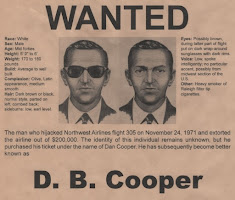
D.B. Cooper: Brushing Heaven’s Gate With a Landing Light
| D.B. Cooper...or whatever... |
Do not
look for him
In
brittle mountain streams
And do
not examine the angry rivers
For shreds
of his body
Or turn
the shore stones for his blood
But in
the warm salt ocean
He is descending
through cliffs
Of slow
green water
And
hovering colored fish
Kiss his
snow-bruised body
And
build their secret nests
In his
fluttering winding-sheet
-
Leonard
Cohen
-
He hails from 1971 but the vibe is sooo 60s. He’s Clyde Barrow with a parachute. He’s Randle McMurphy escaping into the midnight trees. Nobody really knows anything about D.B. Cooper, except that he hijacked a Boeing 727, got $200,000, and jumped out at 10,000 feet with a parachute over southwest Washington State. Pitch black. Raining. Never seen or heard from again. No body. No parachute. Nada. The snake eats its tail.The crime remains the only unsolved air piracy in commercial aviation history. It’s driven people crazy. Thousands of books and articles have been written. There are a million theories. Why? Ask yourself why?
The FBI has given up. Exhausted after decades of futility... He’s gone baby gone, this black-feathered defrocked angel that ordered a bourbon and soda, stared out the plane’s window, then vanished forever into the night, as if he was never there; as if he never existed. He is Camus’ Meursault, but more than an outsider—someone who has no need for terra firma; a fading phantom who cannot be traced through corporeal stigmata.
They could never find him because they were always looking down.
This narrative is clearly airborne. It
has to do with winding jet streams and falling into the sky and holding onto the back of that silent condor as it
sweeps up to the moon and brushes heaven’s gate with a landing light.
#dbcooper #hijack #cult #criminal #1971 #boeing #popculture
Monday, January 3, 2022
Kurt Vonnegut: Trapped in the Amber of this Moment
Kurt Vonnegut had seen war close up with burning
fleshing in the air and eventually counterbalanced the horror with child-like euphemisms.
An obvious humanitarian, Vonnegut was wary of
humanity. Slaughterhouse House Five,
which he claimed to be his best book, isn’t about World War Two so much as it’s
about the kind of people who participated
in the war and how it affected them. His skill comes in melding the fantastic to
the ordinary—and in that way explains how easily evil may overcome good, and
vice-versa.
Like Hemingway, his sentences are deceptively simple. With Vonnegut, you’re misled by the often sophomoric humor, glib insights or near-cartoon characters. Then, later, the full force of the message hits you and that rare and precious reader-writer connection clicks in.
Initially embraced by the 1960s counter-culture, Vonnegut aged without
relinquishing his Mark Twain follicles and cigarettes, his mustache sagging
under the weight of worries—that humans might not make it over the fence; that
people are too smart in the wrong way.
There is a Zen quality to his writing, as if he’s seeking the tranquility
to be found in the acceptance that no one, ever, has really understood life.
---
“Why me?"
“That is a very Earthling question to ask, Mr. Pilgrim. Why you?
Why us for that matter? Why anything? Because this moment simply is. Have you
ever seen bugs trapped in amber?"
"Yes."
- Well, here we are, Mr. Pilgrim, trapped in the amber of this
moment. There is no why.”
- Slaughterhouse
Five
Tuesday, October 19, 2021
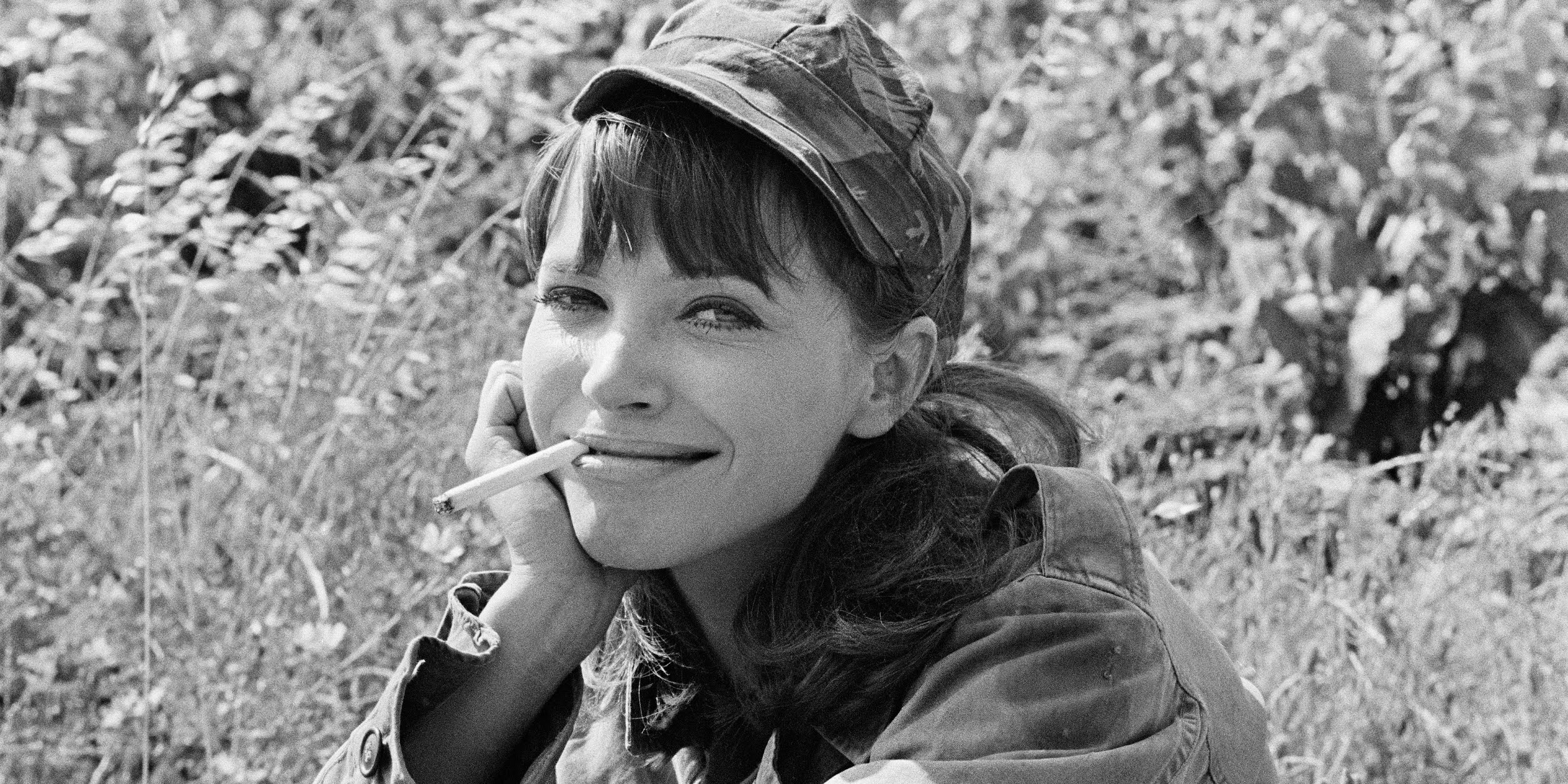
Anna Karina: The Importance of the Moment
She didn’t belong with the hippies. She wasn’t rebelling. She wasn’t stoned. With Anna Karina, you could see the love of life was on her face, even when bathed in a vale of tears.
There seemed to be a Zen-like acceptance of the here-and-now, no yesterday and maybe no tomorrow. Her pursuit of the present was irresistible.
She might dance now. She
might cry or adjust her beret. It was the ‘moment’ and you couldn’t look away.
There was no need for a narrative or three-act structure or character deficits.
There was just Anna.
It was a charmed life (often the gods are kind to those with no agenda)...as if the French New Wave just happened to her. With her pale face and dark eyes, there’s a lightness to her that is ghostly. We see her forever in a school-girl outfit, pleated skirt and sweater: it wasn’t innocence; it was detachment.
In her face
and body and attitude was an expression of the unshakable confidence that comes
with the serenity of freedom: she was
what the 1960s always wanted to be.
Thursday, June 10, 2021
Amanda Lear: A Riddle inside an Enigma Wrapped in a Sequin Gown
Was she born a man? A woman? When? 1939? 1941? Where? Saigon? Hong Kong? Singapore? Switzerland? And why is her voice so deep?
Who was/is/will be Amanda Lear?
Questions without answers. Yet there she is – beautiful, vivacious, easy to laugh, rushing to the next party, posing for Salvador Dali, hanging with the Beatles and Stones. She models for prominent designers. She’s a cover girl on fashion magazines.
David Bowie pays for her singing lessons and off she goes to become a big star in France and Germany. A disco queen. A professional muse. She paints canvas. Dali paints her. She poses for Playboy.So easily bored. Amanda writes songs. She has lovers. She is a gay icon. She doesn’t belong in the 1960s/70s/80s/90s because she has no use for time.
The real Amanda can only be seen by moonlight in a patina of pixie dust, sprinkled by a wayward nymph on her lazy way to nowhere.
The
best mystery enjoys unending immunity.
Friday, April 16, 2021
Sophia Loren: Of Strangeness in the Proportion
“There is no
exquisite beauty… without some strangeness in the proportion.” - Edgar
Allan Poe
The eyes, the
nose and the lips – the proportions are odd, yet together proffer an allurement
more supplication than seduction. If sound took form we would see harmony.
Her face remains more in memory than on a screen – for that’s where she belongs amid timeless shadows and sighs, the candle-lit embrace under a windswept moon with everything drifting out to dawn.
She could only come from an old land of sun and sea where the past is bemused by the present, knowing the love of life leaves you untouched by time. You can see it in her smile and the way she swirls her skirt. When she’s around, you don’t need a clock.
Monday, March 15, 2021
Stuart Sutcliffe: Those We Leave Behind
"[He is my]
alter ego ... a spirit in his world ... a guiding force.” – John
Lennon
It would be cosmically ironic if Stuart Sutcliffe (1940-1962), an original member of The Beatles, ever wanted to be a famous musician. But he quit the group early on to begin a life behind an easel, not a guitar. Anyway, he had the eyes of a painter, not a musician.
The universe-wide
divide between the anonymous solitude of his death and the raucous, global fame
of the Beatles leads us to question the role of those we leave behind. Does
their essence – like static, temporal monuments - demark the progress of our
lives, or are they as unchained as the wind, always with us, changing but
unchanged?
Just listen to
the way he sings Love Me Tender with an ethereal, driving determination - like
a playful prayer - sure to leave footprints in the sand.
Friday, January 22, 2021
Jerry Lewis: Show-stopping Banality
To many of us, his talent isn’t obvious. Too much noise always gets in the way. Ego. Insecurity. Immaturity. Neurosis. Some performers are empowered by their deficits; Jerry Lewis’ took him just so far, and then left him stranded and exposed, swooning in self-pity or foaming over persecution by an illusory cabal of envious insiders.
It wasn’t long
after the war and the advent of television. America was ready for a new clown.
And there he was, no Emmett Kelly, but somewhere between a schlemiel and a
schlimazel. Whatever, it worked pussycat, and together with his partner, Dean
Martin, he had the world at his feet. And then the ground began to tremble.
With few exceptions, most of his work has chaotic noise that cracks the fourth wall, through which he shrieks to the audience to appreciate his efforts, to applaud his genius, thereby sacrificing character for personal adulation. Jerry can’t seem to help it. He really wants you know, damn it, how f’n hard he’s sweating for your smiles. The self-loathing is palpable.
His talent was
one of daring invention, of wild kinetic energy, unregulated by taste or
refinement. He didn’t follow orders or regulations. He did it all himself.
Jerry Lewis had guts and stamina that pushed him to the front of the crowd –
but once there, he so easily followed the path of least resistance.
His style of
humor was destabilized as the 1960s progressed. Not even Vegas saved him. He
retreated into charities that eventually disowned him. Nowadays, his albums are
rarely played; his films, unwatched, whereas his boozy buddy, Deano, just keeps
burbling along.
Much of Jerry’s
humor had him portraying a man of inferior mental faculties. That hasn’t aged
well. It doesn’t matter because, in the end, it was all about Jerry anyway.
That’s the lesson, pussycat.
Jerry Lewis joins
the immortals with the wondrous, show-stopping breadth of his banality.
Tuesday, December 22, 2020
Neal Cassady: Drive He Said
![]() |
| King of the Road |
“Twenty years of fast living - there's not much left, and my kids are all screwed up. Don't do what I have done." - Neal Cassady
If he was just a clown, a hyperactive dunce, a celebrity buddy, he would have been abandoned by American literature. But Neal Cassady always makes into the footnotes. He’s always there, On the Road with Kerouac or On the Road with Kesey or wherever – he always seems to be moving, vibrating, jabbering and anxious to devour Life just before it devours him.
![]() |
| Cassady & Kerouac: Hit the road Jack |
He drives the beatniks. He drives the hippies. He drives a neon-noir zeitgeist into the perfumed
arms of flower power. He belongs to mid-century America (I like Ike but I dig
Kennedy), a post-war Huckleberry where the Mississippi meets macadam. And like
all travelers who know the real purpose of moving, he never takes baggage because
the game is about escaping, not finding.
- 1968. His last
breaths of life fog cold metal of a railway track at night. There he is, under a
Mexican moon, hanging on, alone, the Holy Goof slowly slips behind the wheel for a velvet drive to the stars.
![]() |
| Always keep moving |
Monday, November 23, 2020
Donald Crowhurst: Just Like You
![]() |
| Looking beyond the vanishing point |
An error
in judgment or a weakness in character such as pride or arrogance helps bring
about the hero's downfall. – Characteristics
of Greek Tragedy, Quizlet
As flies to wanton boys are we to the gods; they kill us for their sport - Shakespeare
![]() |
| Wealth. Fame. Status. |
In 1969, he slipped into the living hell of a dark
mind; at first, intellectualizing his behavior, and then, when the center would
no longer hold, diving into the womb of salvation and peace, a hundred miles deep
in the North Atlantic.
![]() |
| End of the Voyage |
He needed the money for his family, for his dreams, and The Sunday Times Golden Globe Race, a singled-handed, round-the-world race, offered everything. Wealth. Fame. Status. Yet, he had to win. It would take near genius-level cheating, but we all have different talents.
Wait, here’s an
idea to draw less attention: what about a hail-fellow-well-met second
place? The gods must have been bemused to let such a forlorn, sad man drift and
bob across the whirling waves. What a character this Crowhurst was. Let’s blow
his bark into first place. And that was it - the tipping point.
Gone was a
father, a husband, a kind heart and a good sailor. How fragile and weak and
courageous and strong. Exactly like you.
Thursday, October 1, 2020
Mike Nichols and the Rarity of Entertainment IQ
Mike Nichols directs Dustin Hoffman in The Graduate.
If we don’t accept the possibility of genius, it’s difficult to explain how consistently – if not contiguously - successful Mike Nichols was on screen and stage. One person can’t direct that many hits; one can’t win that many awards.
Part of the mystery is no mystery at all: Mike Nichols had an odd talent which cannot be learned, copied or modified. He could sense material that had hit potential and was able to dust his work with a patina of artistic refinement. It had quality, not just fame. Very rare.
![]() |
| Nichols, Taylor, Burton on the couch in Virgin Woolf |
Beginning with the
films Who’s
Afraid of Virginia Woolf (1966) and The Graduate (1967), he
rarely took a false step. Same thing with theatre. Barefoot in
the Park (1963) kicked it off and he just didn’t quit.
Born Mikhail Igor Peschkowsky, in Berlin, in 1931, Nichols developed supreme survival instincts. He seemed to know what people wanted, what they liked, what they wished to see – and especially, in the beginning, what made them laugh. Similar to many funny people, he suffered depression, but he endured, and perhaps made the illness an unwelcome attribute.
![]() |
| Mike Nichols: Thinking it out |
Regardless, when
someone is so good at a difficult job, we must take note of the high-water
marks, as if to say, we were lucky that such an artist touched down. Our prayers illume the illusion of life as we watch people
- like Mike Nichols - paint in the dark, fifty feet high.